
Author Information
Awakening to Authentic Connection: John Donne's 'The Good-Morrow' Through Neurodivergent and Inclusive Lenses
Folder:
Sonnet Sleuths 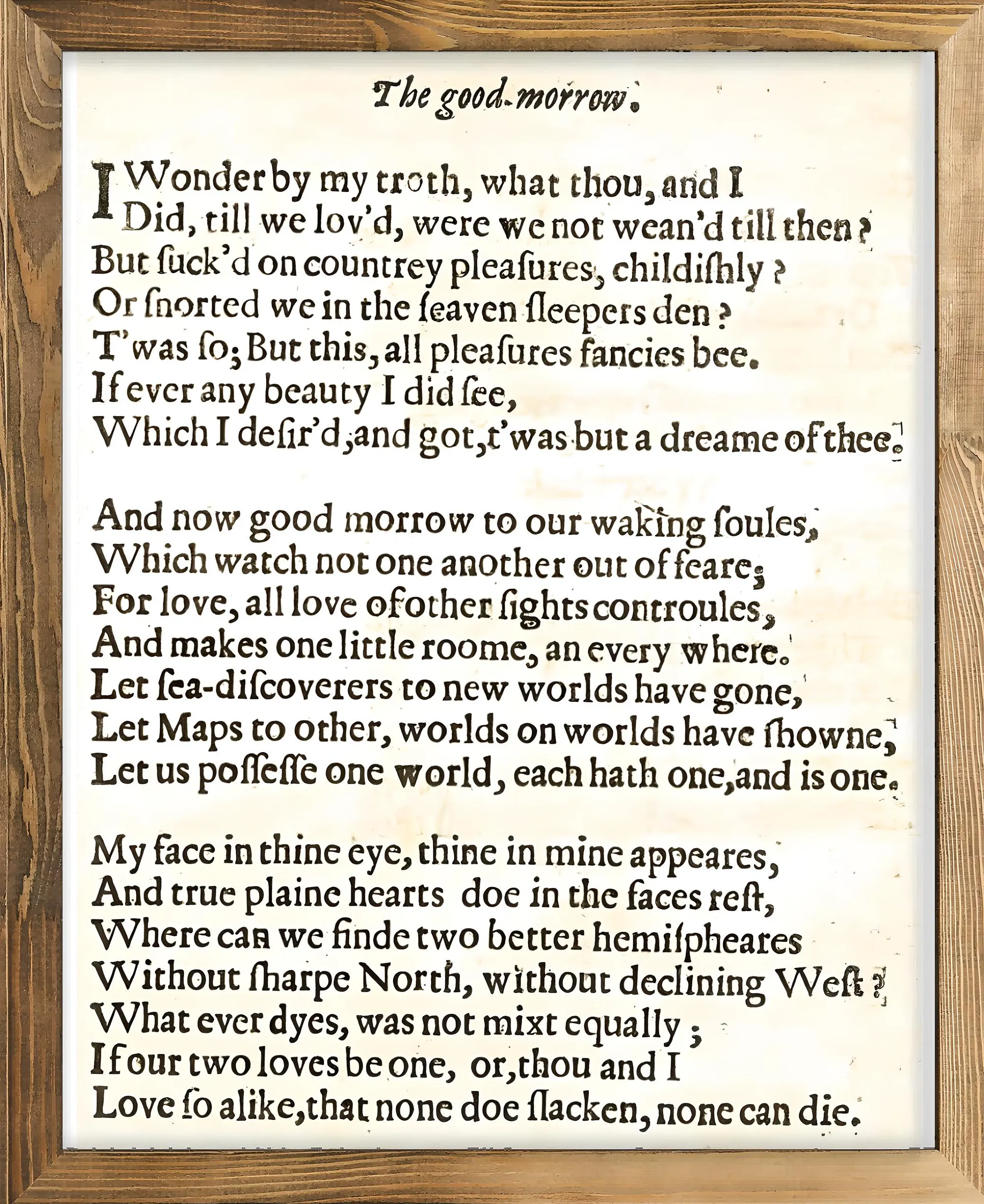
Introduction: When Literature Becomes a Mirror for Life
Have you ever experienced a moment so powerful it split your life into "before" and "after"?
Awakening isn't always gentle. Sometimes it strikes like lightning, disrupting and illuminating everything until the world reshapes itself beneath our feet. My own "good morrow" began not with a sunrise, but in a Melbourne adult education class in 2011. After emerging from eight years of rehabilitation following a life-changing accident, I discovered John Donne's timeless poem.
Its 400-year-old metaphors resonated deeply with my late realisation of neurodivergence and my journey towards genuine connection—a journey of coming to terms with this new understanding and figuring out what it truly means in practice. As someone who spent decades masking neurodivergent traits, my sexuality, and gender while navigating a world that often felt bewilderingly unwelcoming, I found Donne's exploration of awakening was more than just poetry—it was recognition. Here was proof that I was not alone; here was a voice that understood what it meant to suddenly realise you'd been sleepwalking through your own existence until something, or someone, helped you truly see.
This analysis invites you to find your reflection in that same mirror, exploring how a 17th-century poem can shed light on our most contemporary struggles with connection, identity, and inclusion.
Historical Context and the Metaphysical Tradition
John Donne (1572-1631) pioneered metaphysical poetry, characterised by intellectual complexity merged with passionate emotion. Within his canon—alongside "The Sun Rising" and "A Valediction: Forbidding Mourning"—"The Good-Morrow" exemplifies the tradition of yoking together disparate ideas through wit and emotional depth.
The original 1633 publication featured the long s (ſ), rendering words like "ſeaven ſleepers" in ways that remind us language itself constantly evolves. This typographic detail parallels how different communities possess equally valid ways of understanding awakening—a principle central to inclusive analysis.
The Architecture of Awakening: How Structure Creates Safety
"The Good-Morrow" unfolds in three carefully crafted stanzas, each containing seven lines with an ababccc rhyme scheme. This tripartite structure isn't merely a matter of technical precision—it creates what trauma-informed educators recognise as predictable scaffolding that allows for emotional risk-taking.
Metrical Analysis: The Heartbeat of Awakening
The poem's predominantly iambic pentameter creates a reassuring rhythm, while strategic variations mirror emotional disruption:
I won|der by | my troth, | what thou | and I
˘ ´ ˘ ´ ˘ ´ ˘ ´ ˘ ´
(Regular iambic pentameter establishing conversational tone)
Did, till | we loved? | Were we | not weaned | till then?
´ ´ ˘ ´ ´ ˘ ´ ´ ´ ´
(Trochaic substitution creating emphasis on "Did")
This metrical disruption mirrors the emotional disruption of awakening—form embodying meaning.
Cultural Frameworks for Understanding
The poem's movement—past (ignorance), present (discovery), future (transformation)—resonates across cultures:
|
Framework |
Past |
Present |
Future |
|
Western Tradition |
Thesis |
Antithesis |
Synthesis |
|
Indigenous Australian |
Ancestral Dreaming |
Community Connection |
Future Generations |
|
Educational Psychology |
Unconscious Incompetence |
Conscious Competence |
Integrated Mastery |
|
DW-CONNECT |
Preparation |
Discovery |
Transformation |
From Sleep to Waking: Multiple Paths to Understanding
Opening with Yarning
"I wonder by my troth, what thou and I / Did, till we loved?"
Donne begins not with a declaration but with an invitation—what Indigenous educators recognise as "yarning," building a relationship before exploring content. This conversational opening establishes intimacy while posing a universal question: What were we before we truly knew ourselves?
The Seven Sleepers: Universal Design for Understanding
Donne's reference to the "seven sleepers' den" demonstrates how great literature offers multiple entry points—what Universal Design for Learning calls "multiple means of representation":
Christian/Islamic Tradition: Youths sealed in a cave awaken centuries later to find their faith vindicated—speaking to religious or spiritual awakening
Platonic Philosophy: Cave prisoners mistake shadows for reality until experiencing true light—resonating with anyone who's realised they were living an inauthentic life
Indigenous Wisdom: Knowledge emerges through patience, ceremony, and proper timing—honouring different cultural approaches to discovery
Neurodivergent Experience: Late diagnosis or unmasking reveals authentic identity after years of confusion—validating diverse cognitive timelines
In my work supporting neurodivergent learners through DW Tutoring, I witness this awakening regularly—when mathematical concepts suddenly click, when students discover their unique learning style, or when they first experience genuine intellectual confidence without masking.
Present Discovery: The Revolutionary Act of Mutual Recognition
Internal Worlds vs. External Conquest
"Let sea-discoverers to new worlds have gone,
Let Maps to others, worlds on worlds have shown"
Writing during the Age of Exploration, Donne boldly privileges internal discovery over external conquest. While contemporaries celebrated colonial expansion, he argues that authentic connection creates more expansive worlds than any geographic exploration. The transformative line—"And makes one little room, an everywhere"—captures how genuine relationship transcends physical limitations.
The DW-CONNECT Framework in Practice
This concept powerfully supports inclusive educational practice. The most effective learning environments create spaces where learners feel safe to be vulnerable, admit confusion, and experience genuine discovery:
Relationship-Centred: The poem opens with personal connection before philosophical exploration
Culturally Responsive: Multiple interpretive frameworks honoured simultaneously
Trauma-Informed: Predictable structure enables emotional safety
Neurodiversity-Affirming: Different ways of knowing validated equally
Strengths-Based: Past experiences framed as preparation, not deficit
The Mirror of Souls: Technical and Emotional Mastery
Chiasmus as Embodied Meaning
"My face in thine eye, thine in mine appears"
The line's chiastic structure (A-B-B-A pattern) doesn't just describe reciprocity—it enacts it. For those who've spent years masking, this moment of mutual recognition can be revolutionary. The image speaks to anyone who has found in one caring relationship the key to transforming their entire world.
Literary Techniques in Service of Inclusion
Extended Metaphor Development:
- Stanza 1: Sleep/Infancy → Nurturing awakening
- Stanza 2: Exploration/Discovery → Expanding awareness
- Stanza 3: Astronomy/Balance → Eternal understanding
Sound Patterns Creating Meaning:
- Alliteration: "weaned...were" (nurturing), "watch...waking" (alertness)
- Assonance: Movement from "good morrow" → "waking souls" → "love controls"
Contemporary Resonances: Ancient Wisdom for Modern Challenges
In our era of fragmented digital attention, Donne's vision of focused, mutual recognition feels both archaic and revolutionary. The poem challenges us: When did we last truly see another person without filters—literal or metaphorical?
Digital Age Applications
- Video calls as modern "face in thine eye" moments
- Social media's potential for authentic connection vs. performance
- Online learning environments require genuine relationship-building
Global Perspectives: Awakening Across Cultures
Donne's exploration of awakening resonates with diverse world traditions:
|
Tradition |
Awakening Concept |
Connection to Donne |
Unique Perspective |
|
Japanese Zen |
Satori (sudden enlightenment) |
"good morrow to our waking souls" |
Individual vs. relational focus |
|
Persian Sufism |
Divine union through love |
"If our two loves be one" |
Sacred vs. secular love |
|
Indigenous Australian |
Connection to Dreaming |
"My face in thine eye" |
Linear vs. cyclical time |
|
Contemporary Poetry |
Identity reclamation |
"were but a dream" to reality |
Historical vs. contemporary context |
Inclusive Interpretations: Diverse Paths to Awakening
LGBTQIA+ Perspectives
The movement from past relationships that "were but a dream" to present authenticity resonates deeply with coming-out experiences. The poem validates the courage required for genuine vulnerability while celebrating love that transcends societal expectations.
Neurodivergent Insights
As someone diagnosed with autism, ADHD, and complex trauma later in life, I recognise my own journey from masking to authenticity in Donne's awakening metaphor. The poem's celebration of moving from what "seemed" meaningful to what truly is echoes countless neurodivergent experiences.
Cultural Responsiveness
Different cultures understand awakening through distinct frameworks—such as ceremonial timing, mindfulness, ancestral wisdom, or natural variation. Rather than competing, these perspectives enrich our understanding of Donne's universal themes.
Educational Applications: From Page to Practice
The "Good-Morrow" Method for Inclusive Teaching
|
Stanza Stage |
Classroom Application |
DW-CONNECT Principle |
|
Opening (Past) |
Yarning, building trust, acknowledging prior knowledge |
Relationship-centred |
|
Development (Present) |
Multiple entry points, diverse examples, collaborative discovery |
Culturally responsive |
|
Integration (Future) |
Synthesis, personal application, transformative understanding |
Strengths-based |
Assessment Through Multiple Lenses
- Reflection journals: Personal awakening narratives
- Creative responses: Visual, musical, or dramatic interpretations
- Community connections: Cultural context applications
- Peer teaching: Sharing interpretations with others
Conclusion: Your Invitation to Continued Awakening
"The Good-Morrow" reminds us that awakening isn't a singular event but an ongoing practice—a daily commitment to seeing and being seen. Four centuries after Donne penned these lines, they still map the territory between isolation and connection, performance and authenticity.
This journey forms the heart of both the poem and the DW-CONNECT framework, affirming that transformative learning happens not through simple content delivery, but through the patient, daily practice of creating safety, honouring diverse ways of knowing, and celebrating the revolutionary act of connection.
Continue the Conversation
This analysis represents just one awakening among many possibilities. What has this exploration awakened in you? Which lines resonate with your experience? How will you create spaces for others to awaken?
Share your insights and join the discussion below. Let's continue this 400-year conversation together.
David Wakeham is an educator specialising in inclusive, neurodiversity-affirming approaches through DW Tutoring. This analysis is part of the Sonnet Sleuths collection, celebrating diverse interpretations of poetry in welcoming environments where every perspective contributes to collective understanding.
Further Resources:
- Complete Donne poetry collections
- Contemporary neurodivergent poetry
- Cross-cultural awakening narratives
- DW-CONNECT framework documentation
View the complete multimedia version with all visual elements, reflection prompts, and interactive components at https://medium.com/sonnet-sleuths/donne-good-morrow-neurodivergent-analysis-ad2fe9deb816

